

Giving
Meet the Blattners – Leveling the Playing Fields
An Alcalde couple creating opportunities for others.
Story David Bolling
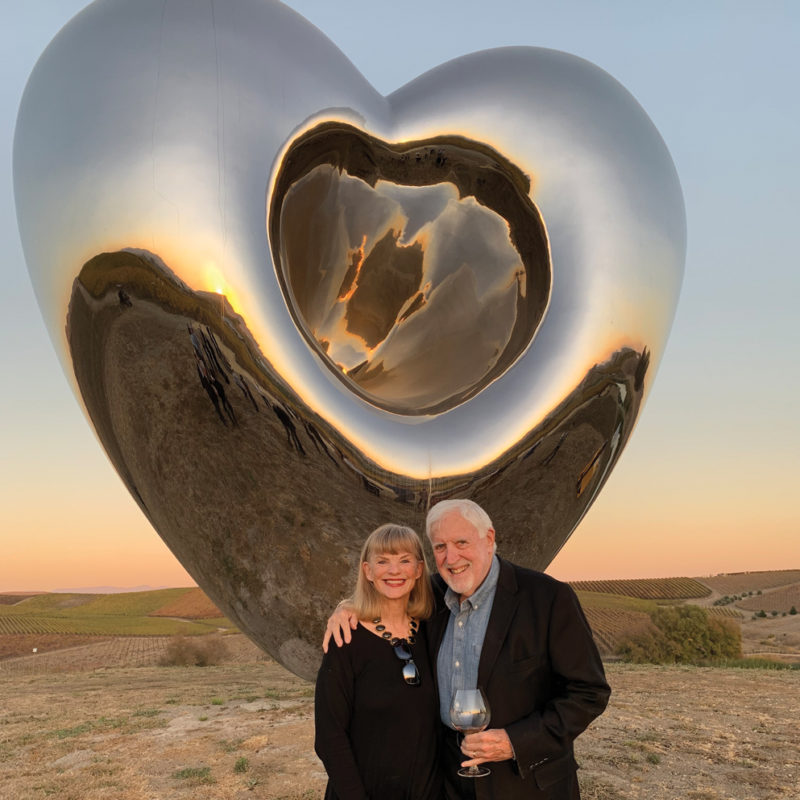
If Kimberly and Simon Blattner had not been jointly chosen for Sonoma’s highest honor, either one of them could have been (and should have been) chosen separately. They are both serial givers.
Which would have been both very right and very wrong.
The Sonoma City Council’s own press release admitted as much, when announcing the Blattners had been selected as Alcalde and Alcaldessa for 2020.
Honorees are nominated by Sonoma Valley citizens, and one of the Blattner nominations, the city’s press release revealed, stated that, “When discussing the breadth of their contributions, it was realized that each of them individually would qualify for nomination as the 2020 Alcalde.”
Sonoma’s annually selected Alcalde (or Alcaldessa) serves as honorary mayor, presides over the Fourth of July festivities and assorted other activities, and takes possession for one year of a stately, silver-headed cane.
Typical nominees are known for their voluntary community service, although being overly known may be a handicap since self-promotion is considered a disqualifying quality. Other important attributes are nonprofit and community project leadership; consistent behind-the-scenes good deeds; and a high standard of moral and ethical values.
The nominee(s) have to reside in the City of Sonoma or onoma Valley, and may be either an individual or a couple. Eight prior honorees have also been couples, most recently including Ted and Pat Eliot, in 2017, and Les and Judy Vadasz in 2013.
Nominating either Blattner separately would have missed half the magic of a synergistic relationship that has nourished nonprofit organizations and community causes for more than 30 years, both in San Francisco and Sonoma Valley.
Between them, and sometimes successively, they have provided leadership, guidance, vision, funding, and fundraising to La Luz Center, the Sonoma Valley Museum of Art, the Sonoma Valley Hospital Foundation, the Sonoma Land Trust, the Sonoma Valley Fund, the Valley of the Moon Music Festival, the California College of the Arts, the City of Sonoma Community Services and Environment Commission, Impact100, Presidio Hill School, Philharmonia Baroque Orchestra, the SFMOMA Docent Council, the League of Women Voters of Sonoma County, Enterprise for High School Students, the American Jewish Congress Western Division, the San Francisco Local Development Corporation (which Simon founded to develop minority businesses) and, more than likely, a few more organizations and causes overlooked in the flood of professional and financial philanthropy.
For two people who between them have transited multiple marriages, disparate careers, and different geographies (she grew up in Oregon, he in Lima, Ohio) it seems both remarkable and somehow fated that they would end up together.
As Kimberly tells the story, “My sister knew Simon socially, for probably eight years, before we met, and told me for eight years that this was the man for me. But I wanted to have more children and he was 12 years older, and I knew he had three children already grown. So I thought, ‘No, I don’t need to meet him.’ And then they had this dinner party and, literally, we sat next to each other, and probably talked for three hours, and we both went home and broke up with the people we were going out with.”
But that first meeting wasn’t enough to close the deal on marriage, and Simon wasn’t inclined to go there. “I didn’t want to get married again because I had managed to do a very poor job of it the first couple of times. I thought that was enough.” So during “a special dinner,” Simon asked Kimberly to live with him instead. Her answer?
“Are you kidding me? I have a house, a job, and a kid. I’m not going to live with you.”
And then she went a step further. “I said to Simon, ‘It’s pretty easy as a woman, if you want to get somebody interested in you, to be fantastic and flirtatious and sexual and all those things that you want a woman to be. But I want somebody to love me for none of those reasons. I want someone to look at me and love me when I’m at my worst, when I’m looking horrible, when I’m pissed off, when I’m this, when I’m that, whatever. That’s when I want someone to love me.”
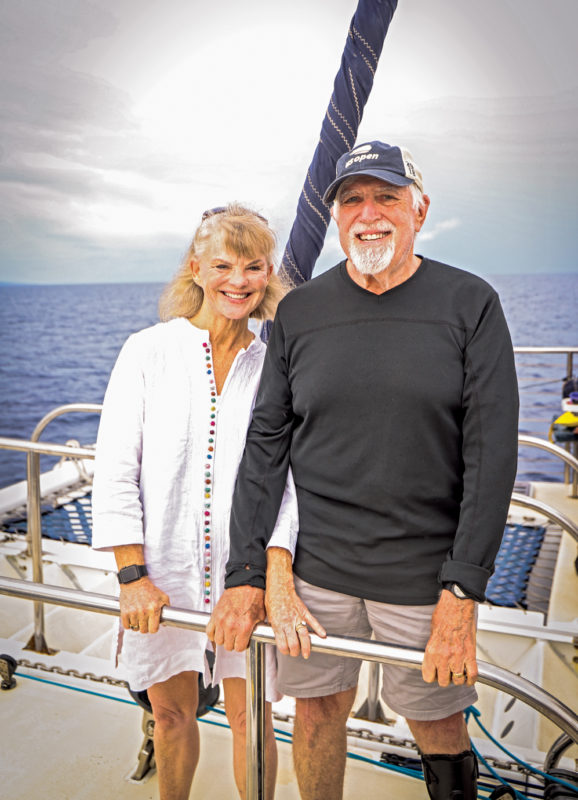
Not long afterward, Kimberly was at Simon’s in San Francisco, having to prepare for a social function of his she didn’t want to go to, after a hard day when one of her Sonoma students was expelled from school. She had her hair in rollers, she was in the shower and really feeling down.
Simon, who unbeknownst to Kimberly had already bought a ring, suddenly realized, “Whoa, wait a minute, she’s pissed off. She’s in the shower. She’s not looking good. She’s all of this…”
Simon goes to the bathroom and says, “Turn off the water, I have to talk to you.”
Kimberly says, “I’m taking a shower.”
Simon persists, “Turn off the water, I have to talk to you.”
Kimberly turns off the water and opens the shower door. She’s naked. In curlers.
Simon says, “You are the most beautiful, fantastic woman I have ever met in my life. Will you marry me?”
She did.
Kimberly and Simon had similar passions, including politics (he had a degree in political science from Northwestern University and once marched with Martin Luther King), both liked the outdoors and both were sports fans, although Simon says, outside of tennis, he wasn’t much of an athlete. He also had an almost visceral attraction to paper—archival paper, artisan paper, paper books—and was deep into a 35-year career as president and CEO of Rittenhouse Paper Company in Chicago, which was, among other things, the biggest manufacturer of fax paper in the world.
Kimberly had moved to Sonoma in 1981, then went through a divorce a year later. She and Simon, she says, “were both married the first time when we were 21, and what did we know at 21? We were just not accomplished adults yet.”
She had a political science degree from Stanford, where she captained the women’s swim team, and then got a master’s degree in elementary and secondary education at UC Davis. Kimberly had been teaching American Government earlier, and following her divorce she applied for a teaching job at Sonoma Valley High School but was told, she says, ‘Well, the theater teacher is on maternity leave and they’ve just started the next production. Can you put on Oklahoma?’ I said, ‘Of course I can put on Oklahoma.’ But, of course, I couldn’t.”
Showing the creative ingenuity and determination that have become hallmarks of her nonprofit work, she promptly took the production stipend, some $300, to hire a local theater director to direct the production while she managed it. “So,” says Kimberly, “for each of the theatrical productions we had for the next five years, I hired somebody so the kids had this great experience of all these different approaches, which was really great. And probably, by the end of five years, I could have directed a play myself.”
Kimberly taught English at the high school until 1990, the last three years as chair of the department.
Simon, meanwhile, had developed this deeply personal interest in paper. That happened, according to Kimberly, following what amounted to an intervention by some of Simon’s friends. “When he got a divorce from his second wife in San Francisco,” she explains, “he was a complete mess and didn’t know what to do. His friends said, ‘You need to go and see a therapist.’ So, he goes to the therapist, and the therapist said, ‘You need to get out of your head and into your body.’ So because he owned a paper-making company, he looked on the web and he found out that Magnolia Editions (a fine arts studio in Oakland), taught a papermaking class through the California College of the Arts. So he took the papermaking class without one iota of knowledge that he had any artistic talent, and he became a fantastic paper-maker.”
She adds, “A whole new side of his life developed in the art world that would have been completely unknown to him. And it’s been fantastic in terms of the art museums and other art things that we’re involved in.”
Ask him what it is about paper and Simon immediately smiles. “Oh, it’s very tactile. It’s absolutely fantastic. And my ambition was to make the best Japanese hand papers in America that you could print on.”
Eventually, Simon created his own fine arts and print studio, called “Eastside Editions,” published a number of handmade books, and recently published his own book detailing how he fell in love with paper, printing, and artists’ books. Titled Libros de Artista, the bilingual book profiles 15 contemporary artists’ books from Mexico.
The papermaking experience led to a nearly decade-long relationship with Magnolia Editions, an even longer relationship with the California College of the Arts—where he became chair of the board, and where he recently was honored with his name on an apartment-style student housing complex for more than 200 students in San Francisco. Simon developed the property himself to provide below-market-rate housing to CCA students so they wouldn’t be competing in San Francisco’s inflated housing market.

Among his numerous other activities, Simon maintains a small but profitable real estate development business, primarily to fund his and Kimberly’s philanthropic activities.
“One of the reasons I’m still working,” he says, “is to give a lot of money away.”
The primary focus of that giving, he says, at least as of November 16, 2016, is the Sonoma Valley. That’s when a national election convinced them, as Kimberly explains, “that there wasn’t very much impact we could have at the national level, and what we wanted to do is start in our neighborhood first and see how things could expand.”
It should be understood that neither Blattner grew up rich. Kimberley’s father, a standout Stanford football guard who played without a helmet during the 1940s—including two Rose Bowls—became gradually incapacitated, alcoholic, and eventually couldn’t work. He died at age 50, clearly suffering from what we now know as Chronic Traumatic Encephalopathy (CTE) caused by football concussions.
Simon’s father owned a department store and was well off until the business collapsed. Both Blattners worked their way through college, Kimberly with an athletic scholarship. And they have clearly done very well for themselves. Which is part of what drives them. Explains Kimberly, “One of the real themes Simon and I have, in terms of the community, is that we really feel a tremendous sense of privilege. It’s always my mantra that we’re aware of being born white in the United States to highly educated parents, so we were already on third base. So every organization that we get involved with, we basically see missed opportunities for other people, and we want to make sure that everybody else has the same opportunities we had.”
Adds Simon, “The two of us want the community to be less ‘us and them.’ Other people don’t have any access to health care. I can go anywhere I want. So we’re trying to level the playing field in everything we do. We can’t do everything, but we can make it better.”
Impact100 Reinvents Philanthropy for Women
A decade of $100,000 grants changes the destiny of Valley nonprofits.
Story Jonah Raskin
If liberated women have known for years that “Sisterhood Is Powerful,” they’re now saying, increasingly, that Sisterhood plus generosity not only empowers women, but also helps change the world for the better. One vehicle for that kind of generosity is Impact100, a democratic decision-making and focused philanthropy in which at least 100 women come together in one community, each woman donates $1,000, and that $100,000 (or more) is donated to one local charity.
The idea was birthed in Cincinnati, Ohio, in 2001 by Wendy
Steele, a pioneer in the Women’s Collective Generosity Movement, who reasoned that more good could come from a single, large change-making grant than numerous small ones. The simple model worked. Steele’s inaugural effort raised $123,000 for a low-income dental clinic that was transformed by the grant.
Since then, the model has spread across the country and beyond, and there are now more than 50 autonomous Impact100 chapters across the U.S., the UK, and Australia. To date the collective groups have given away close to $80 million worldwide.
Impact100 Sonoma was launched in 2009, has just closed its first decade, and is now well into its 11th giving year. Lynne Lancaster, one of the group’s founding members and now its co-president, along with Angela Ryan, comes from Minneapolis/St. Paul, which she describes as “an extremely philanthropic area.” Her background was in business, where the bottom line, not charity and compassion, usually comes first. Sonoma isn’t Minneapolis/St. Paul, but it has no lack of generosity. Lancaster ought to know. She’s lived here for 20 years and, as she explains at an outside table on the Sonoma Plaza at Basque Boulangerie, “People are very generous in the Valley. It’s not hard to find women willing and able to give $1,000.” She adds, “You don’t have to be Bill and Melinda Gates to give.”
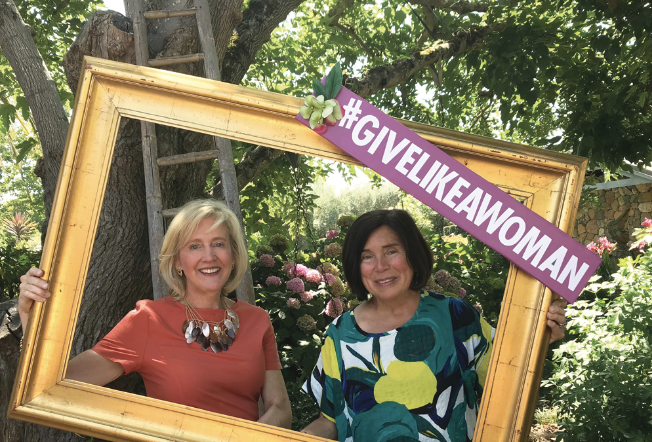
Last year the 300-plus enthusiastic members of Impact100 Sonoma handed out more than $300,000 to nonprofits, including the annual $100,000 impact grant to the Sonoma Valley Community Health Center’s Vision Clinic, as well as a $50,000 Tenth Anniversary Grant to Vintage House, to expand its programs. Over the years the $100,000 impact grants have gone to Las Luz Center, 10,000 Degrees, the Sonoma Valley Education Foundation, among several others. Smaller grants are too numerous to list, but last year they included $20,000 for Art Escape, Ceres Community Project, the Flowery Elementary School PTO, Legal Aid of Sonoma County, Teen Services Sonoma, and the North Coast Conservation & Development Council. From 2010 to 2020, the organization, a 501(c)(3) nonprofit run entirely by volunteers, has given out $2,689,000.
In the beginning, members tended to be older retirees, but now they cross several generational lines, including traditionalists, baby boomers, Gen Xers and millennials. “We’re bringing in younger and younger women,” Lancaster says.
The busiest time of the year for Impact100 is January to June. Grant proposals are due soon after the start of the calendar year. They’re reviewed from February to April, along with on-site visits. Voting takes place in May after the finalists introduce themselves and make presentations. Awards are handed out in June. The whole process, from beginning to end, is transparent and built on trust. “It comes down to trust,” Lancaster says. “We’re not looking over anyone’s shoulder. Indeed, we’re guided by the notion that the groups and organizations that receive grants will do the best they can do with the money.” She adds that nonprofits “often screw up,” but that it’s “OK to make a mistake.” When that happens, Lancaster says, “You fix it.”
Lancaster didn’t start off as co-president, but rather worked her way up the ranks of the organization, putting time in on various committees. Collaborating with other women gives her a sense of purpose. Giving away money provides a sense of joy. What’s harder is raising funds. “That’s the Catch-22,” Lancaster says. “The time it takes to collect money takes away from the giving.” But nothing can cloud the joy of giving a $100,000 impact grant that members know can change the future of charitable organizations and the populations they serve. It’s an empowering program for recipients, and for the mothers, sisters, and daughters who are demonstrating the power of a Women’s Collective Generosity Movement right here in Sonoma.
Jonah Raskin has learned slowly that it can be better to give than to receive.
Twenty-five Years of Mentoring Alliance
More than 2,000 mentees with life-changing relationships.
Story David Bolling
It has been said that we will ultimately be measured not be the money we have earned, the businesses, careers, professions we have built, not by the cars we drive or the size of our homes or the honors and awards we have earned, or even by the number of friends we have or the respect and recognition we receive in our communities.
We will ultimately be measured by one simple standard: the quality of the children we raise.
If that’s not your top priority—and let’s be honest, for many of us it’s not—it may be time to thoughtfully evaluate your life a little, examine where you can invest a bit more of your time with the greatest possible return on investment.
And if you have no children at home, if you’ve already done all the raising you were planning to do, perhaps you’d be open to the possibility that there always have been, and always will be children, in every community, who need some extra help being raised. Children from broken homes, children with cultural, economic, educationa, or emotional obstacles to navigate, children who just need an older friend.
Or, consider this. Perhaps your children are still at home, that they’re loved, and happy and doing well in school and facing rosy futures—or futures as rosy as possible in the overheated world we have consigned them to. Let’s say that’s the case in your life. It might still be possible to find one hour a week to devote to a child whose future doesn’t seem so rosy, a child in whose life you could make a major difference without making a major investment in time.
In the 25 years since the Sonoma Valley Mentoring Alliance was founded by Kathy Witkowicki in a Flowery School custodial closet, there have been somewhere between 2,000 and 2,100 mentor-mentee matches. At least one match has endured the test of those 25 years, in that Howard Gorbach and his mentee, Matt, are still connected, which means, in effect, it’s forever.
And there are current high school seniors who have been mentored since the second, third, and fourth grade.
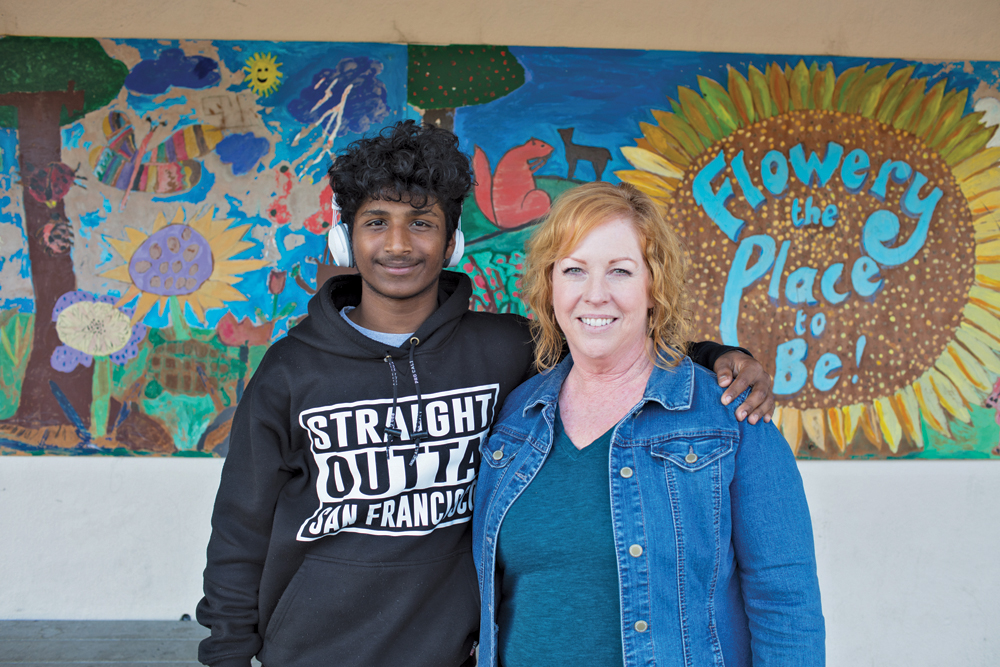
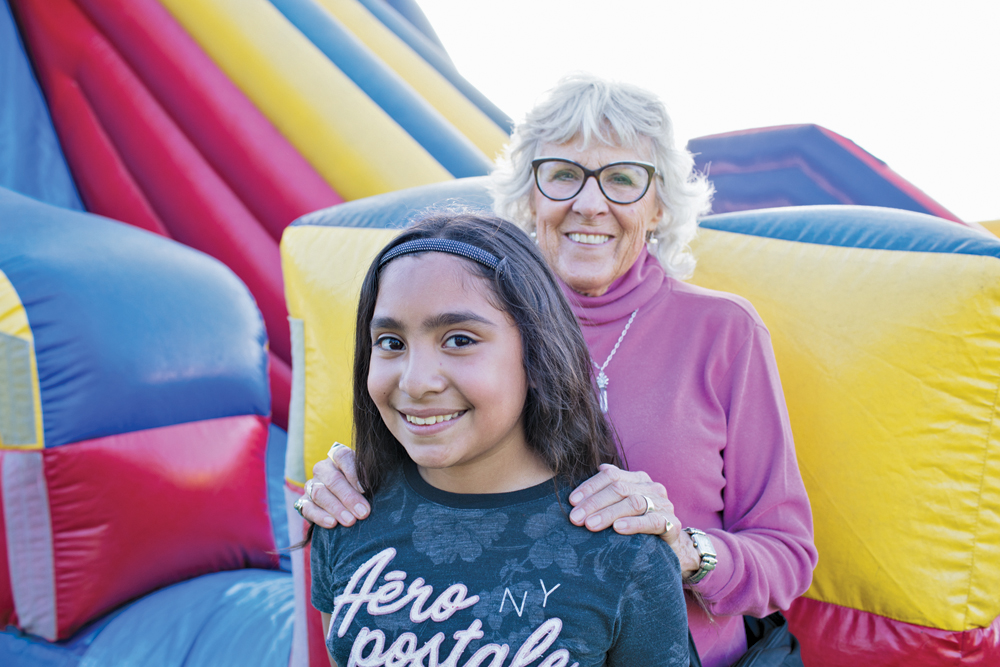
Lee Morgan Brown, the open-hearted executive director of the Mentoring Alliance, lays out some impressive statistics. The national average for the duration of mentor-mentee relationships, she says, is 5.5 months. The current average for Mentoring Alliance matches is 8 years. There’s a reason for that, beyond the exceptionally detailed and rigorous effort to match the right mentor to the right mentee, and that reason is simple. The Mentoring Alliance is a school-based program. Each relationship is started and nurtured within the secure and carefully structured environment of a dedicated Mentor Center on each of eight campuses in the Sonoma Valley Unified School District. It’s a virtually fail-safe system, with a Mentor Center facilitator present at each site to help guide and nurture the process. And they are very invested in their work. As El Verano School facilitator Annette Giroux-Smith told this magazine earlier, “We are the nurturers, the mediators, the matchmakers, the problem solvers, the hostesses, the secretaries, and the messengers. We provide a sanctuary for matches to meet, feel welcome and safe. We are advocates for children and guides for adults. We are role models for our role models.”
With that kind of support, mentors are never left to their own devices; there is continuous guidance available. The only commitment mentors have to make is to be there once a week for an hour, and to be a friend.
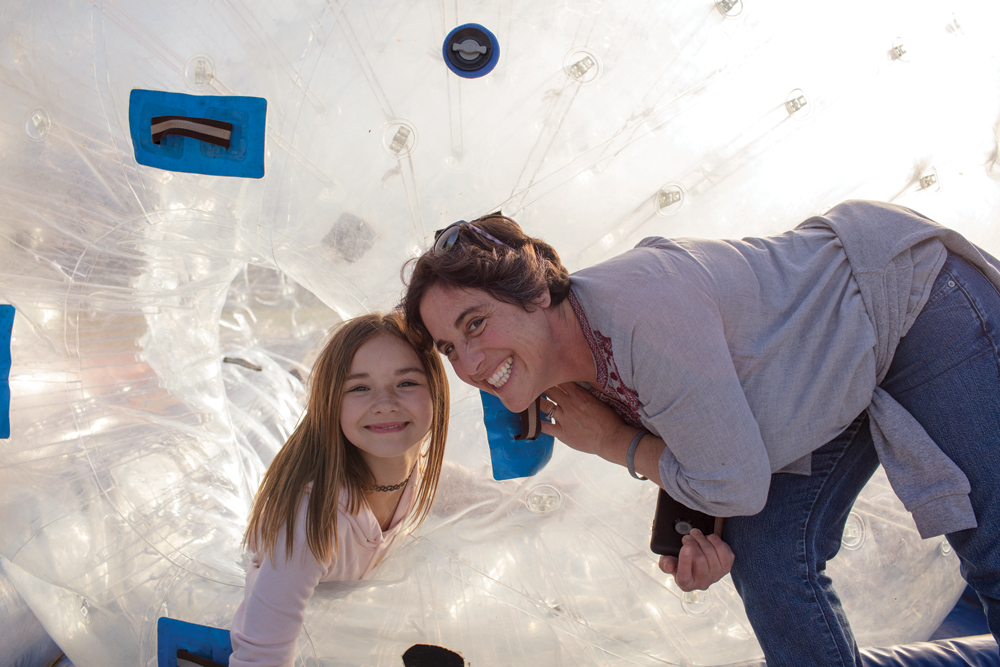
Which leads to the question of time, probably the number one objection voiced by would-be mentors who fear being trapped in a commitment that could disrupt their lives. There’s a pretty simple answer to that concern. An hour a week translates into 8.5 minutes per day. Many of us burn that much time trying to remember where we put the car keys. The truth is, almost everyone has the time.
But there’s another, equally important, truth. As the mentoring relationship progresses it becomes clear, it’s a relationship, not a weekly appointment.
And relationships have a way of leaking outside the box.
It’s totally voluntary, of course, but the odds are good that once you’ve spent that one weekly hour for a few months or a year, that relationship is going to expand into other corners of your life, because you want it to. Because that’s when love rears its head, because that’s what love does. And know this, whether you want it or not, you will be loved, and you will love in return.
Of course, if you absolutely, categorically can’t cough up that hour, there are other needs. It costs approximately $2,000 a year to support each mentor-mentee relationship, including the cost of that mentor center. The Mentoring Alliance budget is about $750,000 a year, and there is no state or federal funding. The money comes from grants, foundations, and generous donors. Perhaps like you.
The difference having a mentor makes in mentee lives is immeasurable. It’s huge. And here’s what a group of grown mentees recently said about the experience.
Isamar: “My mentor has been the one who’s helped me with so many decisions. She never left my side during the fires, when our homes were burned out. I wouldn’t be here today without her… she’s the best thing that’s ever happened to me.”
Traytce: “My mentor has changed my life forever. Mentoring was a great experience for me. I’m now the New Attendance Director for SVUSD. My mentor made me realize that I could do anything.”
Lucia: “My mentor was so patient with me. Her patience and consistency made me open up to her. I knew that I had someone who truly cared about me. She is my family. I’m slowly giving back in ways that I can. She helped me get into programs, encouraged me. I aspire to be what she is. She helped me become the person I am today.”
Mailani: “My mentor came into my life at the most perfect time. I needed a strong female in my life because I had none. Her consistency was so important to me. She totally supports me in my life’s path.”
Luis: “I want people to know how important my mentor is to me and why kids should have a mentor in there life. The outcome of things for the future is so much better and brighter, believe me.”
These mentee alumni demonstrate what Brown describes as the organization’s bottom line. “Self-confident young adults, who are responsible and interested in giving back, will be the future leaders of our town. Investing in them is investing in the future of Sonoma Valley.
This being the 25th anniversary year for the Mentoring Alliance, a notable watershed, it will be recognized and celebrated in various ways through the 2020-21 school year, culminating with a gala dinner on March 6, 2021.
You can find out more by dropping by the freshly relocated Mentoring Alliance office in the Sonoma Community Center building, at 276 East Napa Street. There is always fresh coffee available and answers to every question.
The Gift of Music, Heart-to-Heart
The Gift of Music, Heart-to-Heart
Stephan Stubbins takes his leave.
Of all the ways there are for human beings to give of themselves to each other, music may be the most powerful and immediate gift. It is a heart-to-heart transfer, independent of words, explanations, obligations, or interpretation.
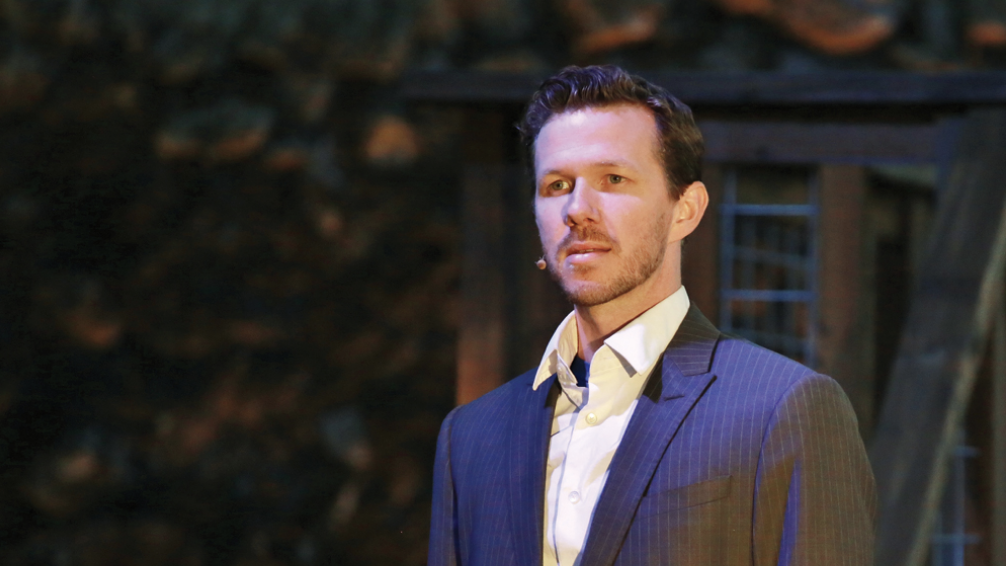
On October 1, 2011, a group of itinerant artists appeared in the winery ruins of Jack London State Historic Park and presented a musical gift to some 900 awestruck citizens that hit them right in the heart. There was astonishment on both sides of the stage, nowhere more so than in one of the principal artists, Stephan Stubbins, co-founder and, until recently, co-executive director of the nonprofit Transcendence Theatre Company, which is now woven into the creative fabric of the Sonoma Valley and far beyond.
Stubbins has taken his leave from Transcendence, to return to his creative roots in New York with new wife and fellow Transcendence performer Libby Servais. He will stay on the board and return to perform with Libby in this season’s Gala production. But for now, there’s a new life chapter to explore.
“It’s been a life-changing journey,” he says. “From the very beginning, the wild and wonderful exuberance, the energy that was in our hearts, to go through three years or so of just believing and working toward it, not seeing it come true until we walked into that space and the amazing community of
Sonoma embraced us.
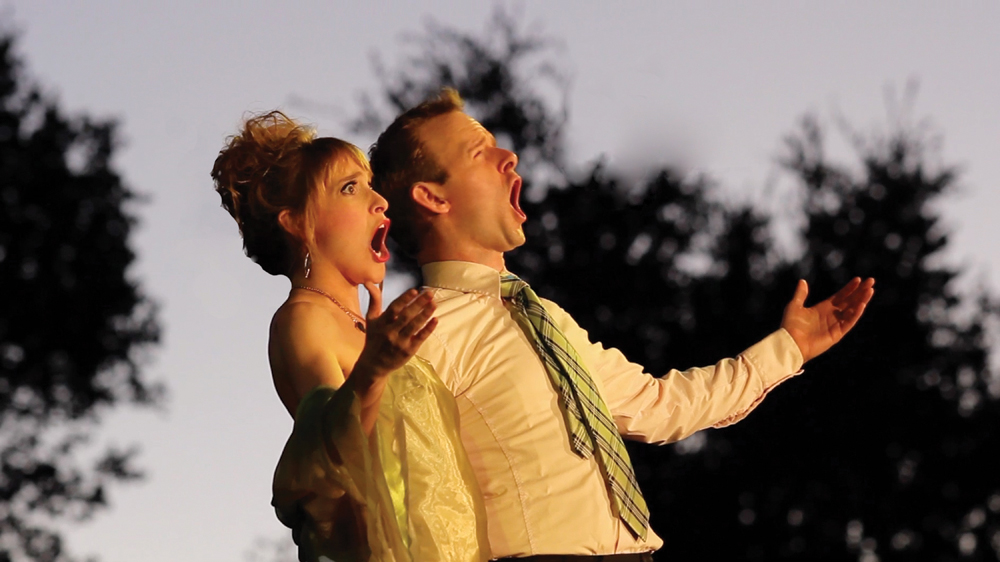
It’s been one of the proudest things that’s ever happened in my life, that this whole community can come together, can open up their hearts and really dedicate themselves to making a difference. I’m amazed by how many lives we’ve influenced and inspired and touched, starting with so little.”
In fact, when they staged that first, trial production in 2011, they had $83 to their names. They have since built a $4 million company, have sung and danced to more than 200,000 people, have produced 50 or 60 different productions, have touched lives young and old, and drawn thousands into the Transcendence vortex in which any dream is possible and anyone can have the best night ever.
“There are certain things we’ll never ever be able to fix,” says Stubbins.
“We’ll never be able to stop hunger, we’ll never be able to get every child with parents that will make them feel loved. We’re never going to get there fully. But we have to continue to plow forward, and we have continued to try to make a difference, because we’re making it better.”
One recent memory—singing Christmas carols at Sutter hospital—captures how quickly a difference can be made.
“We were singing ‘Silent Night’ in the baby wards, and mothers came out of doorways, crying, holding their babies. And we were in another ward, I think it was post-surgery, and somebody just opens this door, and we just see a hand come out, with a thumbs-up. We never even got to see the face.
“So I feel like music is just energy, and it’s being able to take that energy that you can generate in your heart, and through those vibrations, send it to somebody else. And I think that’s the power of music. And that’s what can be so transformative.”
A Vintage for All Seasons
Priscilla Essert touts Sonoma’s home away from home for citizens 55 and over.
Story Jonah Raskin
Photos David Bolling
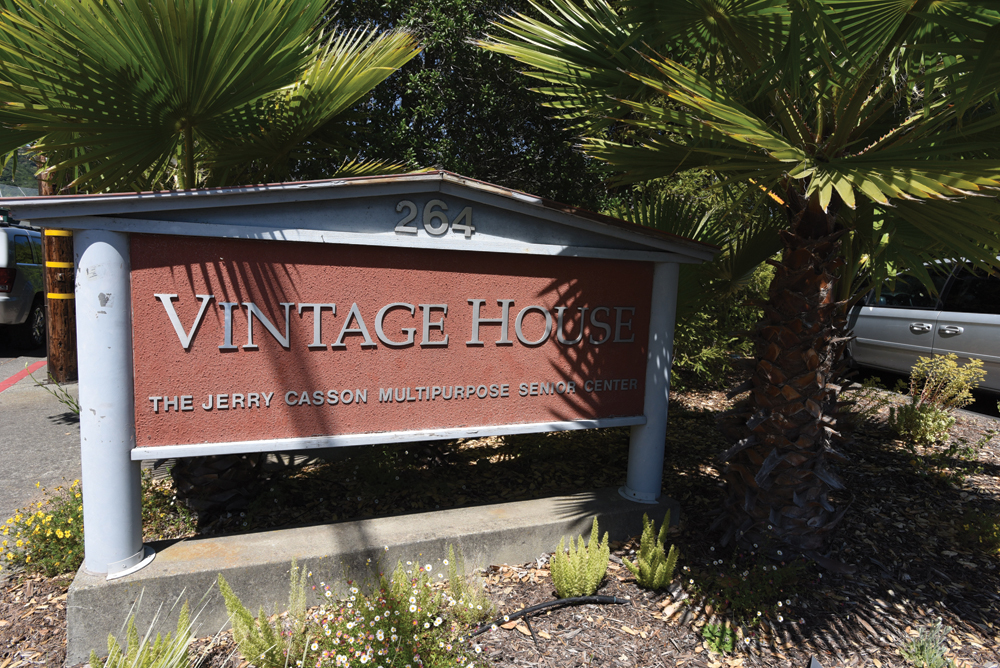
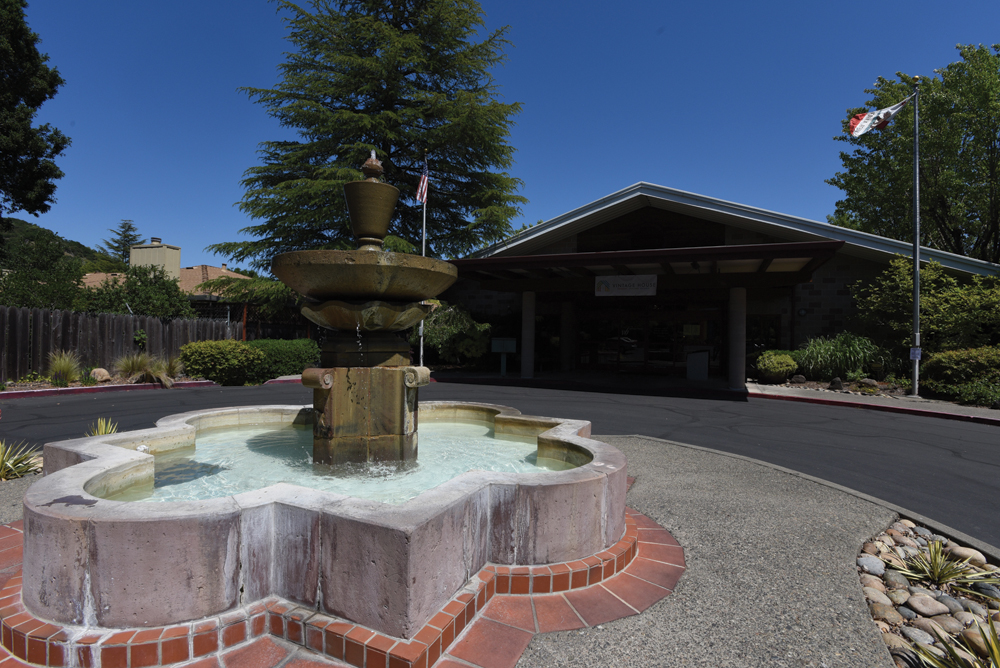
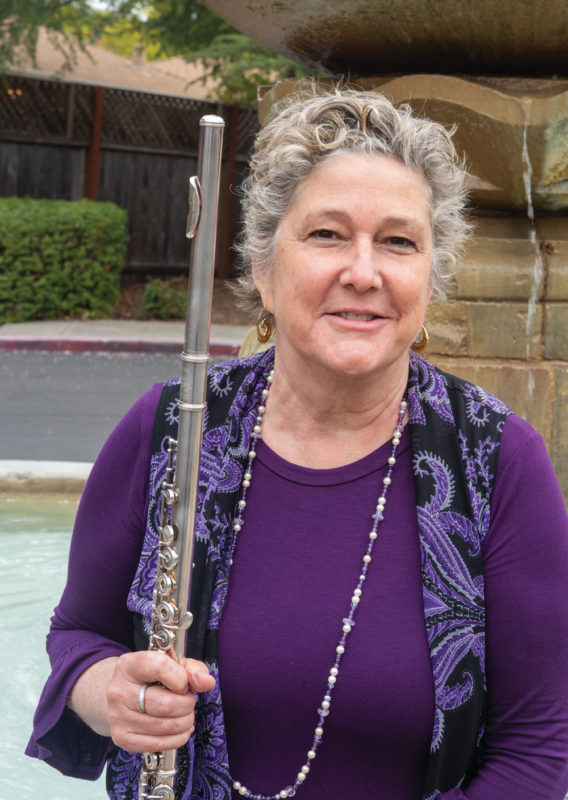
Before Priscilla Essert stepped into the role of executive director at Vintage House last year, she played the flute for the Mexico City Philharmonic and the Berkeley Symphony. She also went on tour with the famed Russian-born dancer Mikhail Baryshnikov, a highlight of her musical career. Essert’s years in the world of dance and music taught her the imperative of working with others collaboratively. “My job at Vintage House feels like making chamber music,” Essert tells me in her distinctly uncluttered office, just off the main corridor, on a Thursday afternoon near the start of spring. A sketch of Mexican artist Frida Kahlo looks down at her as a guiding spirit.
If Vintage House feels like a chamber orchestra, it can also feel like a mini-university, a job-training center, a soup kitchen, and a nonprofit that sustains music, jazz, and the arts. A bustling community, it provides a home away from home for hundreds of Valley residents 55 and over. Just don’t call Vintage House a “senior center” and slam the door shut. Whatever you call it, it’s more ambitious and more effective than any other comparable organization in the county, though Sebastopol and Healdsburg offer somewhat similar, albeit more limited, services. For Essert, Vintage House provides a space for recreation and re-creation.
High-energy, optimistic, and “happily 61 years young,” as she puts it, Essert is a perfect fit for the position. “I love community building,” she says. “I love helping people.” Married to her longtime husband and the mother of two sons, she has lived in Sonoma for seven years. Like many of her contemporaries, she doesn’t care for the word or the concept of “seniors.” She tells me, “We try to avoid it. We don’t care for the word ‘elders’ either, and the phrase ‘senior moments’ is a misnomer.” For many of the members who are 55, 65, 75 and up—Vintage House encourages membership—life is just beginning.
Last year, Vintage House conducted a survey of Sonoma Valley residents who worked for much of their lives, raised families, and found that retirement wasn’t as wonderful as it was made out to be. One surprise was that many in the demographic group were struggling to make ends meet. “Twelve percent don’t feel confident about the future,” Essert says. “Many of them live alone after the death of a spouse and feel lonely.” They tell Essert that they don’t know how to meet people, make friends, and what to do with themselves. Some are itching to get back to work and want job training and help dusting off résumés.
Vintage House provides something for nearly everyone, whether it’s hot jazz, nourishing soup, exuberant Zumba classes or the veritable feeling that they’re staying young in spirit even as they age in years.
Many of the activities are free, though there’s also a sliding scale. Last year, Essert says, Vintage House provided 5,000 free rides for Sonomans. That’s a lot of miles. The organization has a contract with the City of Sonoma, and the city in turn provides funding. Additional revenue comes from fees, grants, private donations, and more.
Essert, who is bilingual and multicultural, wants to reach out to, and be more involved with, the Latino community. “We need to translate flyers into Spanish,” she says. “We could have Mexican food along with ESL classes for men and women 55 and over.” Essert leans forward and looks at her watch. “Americans might reexamine what ‘aging’ means, especially at a time when boomers and millennials are working longer than their parents and grandparents. Here at Vintage House, we have the opportunity to do really innovative and creative things. The sky’s the limit.”
At 78, Jonah Raskin feels young at heart.